Quick, Powerful, and Accurate
Updated: Jun 7
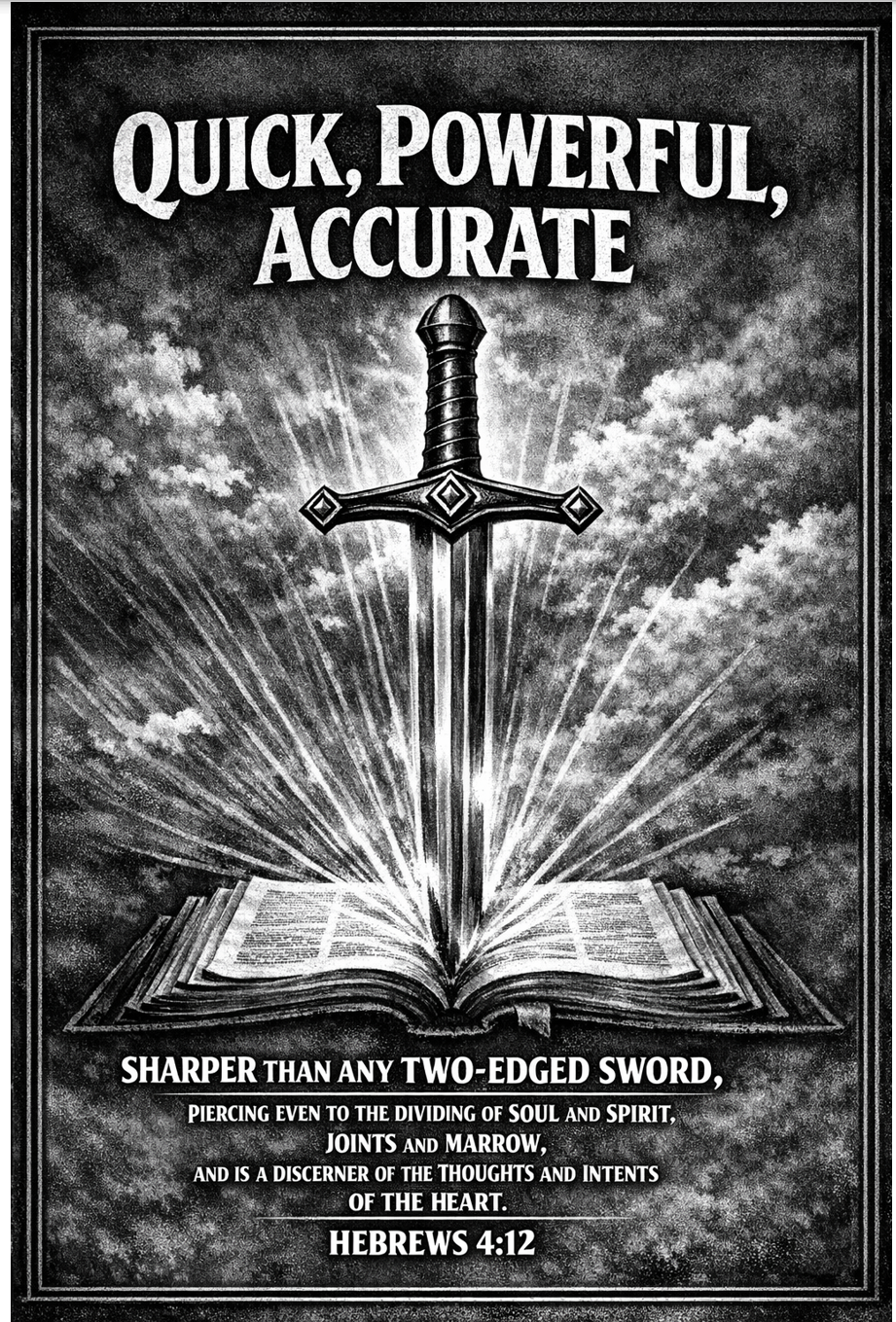
Quick, Powerful, Accurate
A Devotional Journey
Through Hebrews 4:12
The sword is how you find answers.
Preface
There are seasons when a single verse of Scripture becomes more than a verse—it becomes a place of encounter. Hebrews 4:12 is one of those passages. It reminds us that God’s Word is not cold information to be collected, but living truth that searches us, strengthens us, and calls us forward. These pages were written as a four-chapter devotional journey through the living, active, and sharp nature of God’s Word, and the surrendered response it awakens in us. My hope is that, as you read, you will not only understand this verse more clearly, but also experience it more personally—allowing the Spirit of God to breathe life, awaken obedience, refine your heart, and lead you more deeply into surrender in the midst of a world that is often marked by brokenness.
Hebrews 4:12 says God’s Word is living, active, piercing, and able to discern the deepest places of the heart.
Our scripture reference Hebrews 4:12 reveals the Word of God as living, active, and sharp. It brings life where there has been weariness, movement where there has been stagnation, and clarity where there has been confusion. In this mini book, you will reflect on the life-giving power of God’s voice, the active work of His truth, the precision of His searching, and the surrendered response His Word calls forth in us. As you read, let the Lord do more than inform your mind—let Him transform your heart.
Chapter 1 — When Breath Finds Dry Bones
Contemplation: “For the word of God is quick...” (Hebrews 4:12a, KJV)
The word translated quick carries the sense of living, breathing, active life. The Greek term points to more than existence; it speaks of vitality, vigor, and life that is worthy of The Name. God’s Word is alive because God is alive. It does not merely report what God once said; it carries His present breath into our present moment. What feels dry, tired, or lifeless in us is not beyond the reach of the living Word.
In John 6:63, Jesus reminds us that His words are spirit and life. They are not empty sounds or religious ideas, but living truth that reaches the inner person. When Christ speaks, He does not merely offer information for the mind; He releases life to the soul. His Word revives what has grown weak, restores what has become dry, and nourishes us with heaven’s own breath. If your heart has felt tired or burdened, this verse calls you back to the life-giving voice of Jesus.
In 1 Peter 1:23, we are reminded that God’s Word is not temporary or fragile. It is living and enduring, and through it we are born again. Human words can inspire for a moment and then fade, but the Word of God abides forever. It carries within it the power of new birth, fresh beginnings, and lasting transformation. What God starts by His Word, He is able to sustain by that same Word. This means your spiritual life is not rooted in something perishable, but in something eternal.
In Psalm 119:130, we are taught that the entrance of God’s Word gives light. When His truth enters a dark place, confusion begins to break, direction begins to form, and understanding begins to grow. God’s Word does not only comfort us; it illuminates us. It shines into places we could not interpret on our own and gives wisdom even to the simple and teachable heart. When we open Scripture with humility, we open the door to light.
The vision of dry bones in Ezekiel 37:1–10 also strengthens this chapter’s theme. What looked lifeless was not beyond the reach of God’s breath. As the Lord spoke and breath entered the bones, what was dry stood up alive again. In the same way, the living Word still meets places in us that seem exhausted, empty, or beyond renewal, and brings them under the power of His life. As we open ourselves to Scripture, we are not merely reading words on a page—we are receiving the life, endurance, and illumination of God. And as His life works in us, faith works by love, so that what He awakens inwardly is also expressed outwardly in Christlike compassion.
Action Item:
Invite the Lord to breathe life into what has grown weary in you. Sit quietly with Him, ask where you need His renewing breath again, and write what He is highlighting to your heart today.
Questions for Review:
1. What does the word quick in Hebrews 4:12 reveal about the nature of God’s Word?
2. How do John 6:63 and 1 Peter 1:23 deepen the theme of the living Word?
Notes:
__________________________________________________________________________________________________________________________________________________________________________________________________________________________________________________________________________________________________
Chapter 2 — When Fire Walks Through Stone
Contemplation: “...and powerful...” (Hebrews 4:12b, KJV)
The word translated powerful means active, operative, effective, and at work. God’s Word never sits idle. It moves, works, accomplishes, and produces the effect God intends. In a world marked by the pain, brokenness, and suffering that came through the fall, many people feel stuck, weary, or trapped in cycles they did not choose. Scripture calls us out of passivity and into hope-filled obedience. The Word of God is not inert. It is alive in action, calling us forward even in a fallen world. Sometimes that forward movement begins with pruning, as the Lord cuts away patterns of stagnation so that purpose can grow in their place.
In Jeremiah 23:29, the Lord shows us that His Word is not passive. It is like fire, burning through what is false, cold, or resistant, and like a hammer, breaking apart what has become hard and unyielding. Sometimes the Lord uses His Word to comfort, and sometimes He uses it to confront. In both cases, His purpose is mercy. He burns away deception, hardness, and bondage, and He breaks the hold of what would keep us from freedom. The power of God’s Word is not destructive toward us; it is redemptive within us.
In Isaiah 55:11, we are reminded that when God sends forth His Word, it never returns empty. It accomplishes what He pleases and prospers in the very thing for which He sends it. That means the Word of God is never wasted in your life. Even when change feels slow or hidden, Scripture is still doing its work. The Lord’s promises are not fragile, and His purposes are not uncertain. His Word carries divine intention, and it will produce fruit in the season appointed by God.
In 1 Thessalonians 2:13, we are taught that the Word of God is not merely something we hear; it is something that works in us as we believe. When we receive Scripture as truth and not merely as human opinion, it becomes effectual in our hearts. It strengthens conviction, awakens obedience, and produces transformation from the inside out. God’s Word is active not only when it is preached, but also when it is welcomed. The surrendered heart becomes fertile ground for the working power of the Word. Even when progress seems slow, His Word is still moving with divine intention, breaking bondage, accomplishing God’s purposes, and producing fruit in the willing heart.
Action Item:
Ask the Lord what cycle, habit, or place of passivity He is calling you to leave behind. Write your response to His Word and one step of obedience you will take today.
Questions for Review:
1. What does the word powerful mean in Hebrews 4:12?
2. How do Jeremiah 23:29 and Isaiah 55:11 show the active work of God’s Word?
Notes:
__________________________________________________________________________________________________________________________________________________________________________________________________________________________________________________________________________________________________
Chapter 3 — Where the Sword Finds the Heart
Contemplation: Hebrews 4:12 — The Word pierces and discerns the heart
The Word of God gives clear answers, cutting through confusion and laying open what is true. Where the heart is divided or clouded, His voice does not leave us groping in uncertainty. It reaches beneath surface thoughts, exposing what is hidden, discerning what is mixed, and bringing the soul into the light of truth.
The word translated sharper speaks of something keen, decisive, and able to cut with accuracy. The picture is not of repeated hacking, but of a single, clean stroke. God’s Word does not wound carelessly; it cuts precisely. It identifies what is flesh and what is spirit, what is fear and what is faith, what is performance and what is surrender. The sword as the word is sharpness with Holy accuracy, and that is why the sword of the Spirit is how we find answers. When confusion clouds the heart, the Word cuts through the fog and reveals what is true.
In Ephesians 6:17, the Word of God is called the sword of the Spirit. This means the sharpness of Scripture is not merely literary beauty or intellectual force; it is a spiritual weapon placed in the hands of God’s people. The Spirit uses the Word to defend, to correct, to expose lies, and to establish truth. When the enemy whispers confusion, temptation, or accusation, the Word answers with clarity and authority. The sword is how we find answers because God speaks through His Word with precision, cutting away deception and bringing truth into focus. A sharp word in the hand of the Spirit is never careless—it is precise, timely, and victorious.
In Jeremiah 17:10, we are reminded that the Lord searches the heart and tries the inward parts. This connects deeply to Hebrews 4:12, where the Word discerns the thoughts and intents of the heart. God’s Word reaches beneath appearances and beyond performance. It does not stop at what others can see; it searches motive, desire, and hidden intention. This kind of discernment can feel sobering, but it is also merciful. The Lord reveals what is in us so that He may heal, purify, and lead us in truth.
A dull blade requires force and leaves damage; a sharp blade cuts cleanly. In the same way, the Word of God is like the pruning knife in the hand of the Spirit. It removes what hinders life so that fruit can grow. In a fallen world, we experience pain, loss, hardship, and brokenness, but God is not the author of that suffering. Rather, by His Word He meets us in the midst of it with wisdom, mercy, and truth. The Lord uses His Word to remove what has kept you from living out your purpose. But He does more than remove—He also reveals. As His Word searches motive, memory, desire, and intention, it shows where healing is needed, what must be surrendered, and what step of obedience is next. God is not trying to wound or destroy you; He is committed to refining you, restoring you, and leading you in truth.
Action Item:
Ask the Lord to cut through confusion and reveal what is true. Write honestly about what God is exposing, what He is healing, and what step of obedience He is showing you next.
Questions for Review:
1. Why is the Word of God compared to a sharp sword in this chapter?
2. How does the sword of the Spirit help believers find answers?
3. What confusion or hidden motive might the Lord be exposing in your heart?
Notes:
__________________________________________________________________________________________________________________________________________________________________________________________________________________________________________________________________________________________________
Chapter 4 — Between Trees and Surrender
Contemplation: “Not my will, but thine, be done.” (Luke 22:42, KJV)
There are two gardens that changed the course of human destiny: Eden and Gethsemane. In Eden, humanity reached for autonomy, distrusted God’s voice, and opened the door to sin, hiding, shame, and separation. In Gethsemane, Jesus bowed to the Father’s will, accepted the cup before Him, and opened the way to redemption, restoration, and peace. Eden is the tragedy of self-rule; Gethsemane is the triumph of surrender. One garden says, “I will choose for myself.” The other prays, “Not my will, but thine, be done.” That conflict still echoes in every heart. God’s Word confronts the rebellion that hides and calls forth the obedience that restores. When the living Word speaks, masks fall, excuses lose their power, and destiny shifts. Surrender is not loss; it is the place where the Lord frees us from self-rule so that His purpose can flourish. Will we remain among the trees of fear, pride, and self-protection, or will we kneel in surrender and let obedience shape our future?
In Genesis 3:1–10, we see the first garden where the human heart turned from God’s voice and moved into hiding, fear, and separation. In Matthew 26:36–39 and Luke 22:42, we see the second garden, where Jesus faced anguish yet chose surrender, praying, “Not my will, but Yours.” Between those two gardens, Hebrews 4:12 helps us understand what is happening within us: the Word of God searches deeper than outward behavior and discerns the thoughts and intentions of the heart. In Eden, the heart chose independence, and through the fall sin, sorrow, and suffering entered the world. In Gethsemane, the Son chose obedience. The living Word still brings us to that dividing line, exposing whether we are resisting God’s will or yielding to it. What God reveals, He also invites us to surrender, so that His healing and restoring work may meet the places this fallen world has wounded. Allow the living Word do its work. God’s voice is not powerless, and His truth is never careless. It is alive, active, and sharp—and it is even now at work, forming you from the inside out.
Action Item:
Bring your heart before the Lord in surrender. Ask yourself whether you are hiding from His will or yielding to it, and write your response of surrender along with any step of obedience He is placing before you.
Questions for Review:
1. What contrast does the chapter draw between Eden and Gethsemane?
2. How does God’s Word bring the heart to a place of decision and surrender?
3. Where is the Lord inviting you to move from hiding to obedience?
Notes:
__________________________________________________________________________________________________________________________________________________________________________________________________________________________________________________________________________________________________
Closing Declaration
I receive the Word of God as living, active, and sharp in my life. I will not remain stuck in old cycles. I will breathe deeply of God’s presence, move in obedience, and welcome His truth in the deepest parts of my heart. I will allow the Lord to remove every pattern, thought, and attachment that has kept me from living out my purpose. I will not answer God from the place of Eden—fearful, hiding, and clinging to my own way. I will answer Him from the place of Gethsemane—surrendered, trusting, and yielded to His will. The Word of God is working in me, and I will live transformed because of it.
Appendix: Supporting Scriptures
Preface
· Hebrews 4:12 — “For the word of God is quick, and powerful, and sharper than any two-edged sword, piercing even to the dividing asunder of soul and spirit, and of the joints and marrow, and is a discerner of the thoughts and intents of the heart.” (KJV)
Chapter 1 — When Breath Finds Dry Bones
· John 6:63 — “It is the spirit that quickeneth; the flesh profiteth nothing: the words that I speak unto you, they are spirit, and they are life.” (KJV)
· 1 Peter 1:23 — “Being born again, not of corruptible seed, but of incorruptible, by the word of God, which liveth and abideth for ever.” (KJV)
· Psalm 119:130 — “The entrance of thy words giveth light; it giveth understanding unto the simple.” (KJV)
· Ezekiel 37:1–10 — “The hand of the LORD was upon me, and carried me out in the spirit of the LORD, and set me down in the midst of the valley which was full of bones, And caused me to pass by them round about: and, behold, there were very many in the open valley; and, lo, they were very dry. And he said unto me, Son of man, can these bones live? And I answered, O Lord GOD, thou knowest. Again he said unto me, Prophesy upon these bones, and say unto them, O ye dry bones, hear the word of the LORD. Thus saith the Lord GOD unto these bones; Behold, I will cause breath to enter into you, and ye shall live: And I will lay sinews upon you, and will bring up flesh upon you, and cover you with skin, and put breath in you, and ye shall live; and ye shall know that I am the LORD. So I prophesied as I was commanded: and as I prophesied, there was a noise, and behold a shaking, and the bones came together, bone to his bone. And when I beheld, lo, the sinews and the flesh came up upon them, and the skin covered them above: but there was no breath in them. Then said he unto me, Prophesy unto the wind, prophesy, son of man, and say to the wind, Thus saith the Lord GOD; Come from the four winds, O breath, and breathe upon these slain, that they may live. So I prophesied as he commanded me, and the breath came into them, and they lived, and stood up upon their feet, an exceeding great army.” (KJV)
Chapter 2 — When Fire Walks Through Stone
· Jeremiah 23:29 — “Is not my word like as a fire? saith the LORD; and like a hammer that breaketh the rock in pieces?” (KJV)
· Isaiah 55:11 — “So shall my word be that goeth forth out of my mouth: it shall not return unto me void, but it shall accomplish that which I please, and it shall prosper in the thing whereto I sent it.” (KJV)
· 1 Thessalonians 2:13 — “For this cause also thank we God without ceasing, because, when ye received the word of God which ye heard of us, ye received it not as the word of men, but as it is in truth, the word of God, which effectually worketh also in you that believe.” (KJV)
Chapter 3 — Where the Sword Finds the Heart
· Hebrews 4:12 — “For the word of God is quick, and powerful, and sharper than any two-edged sword, piercing even to the dividing asunder of soul and spirit, and of the joints and marrow, and is a discerner of the thoughts and intents of the heart.” (KJV)
· Ephesians 6:17 — “And take the helmet of salvation, and the sword of the Spirit, which is the word of God:” (KJV)
· Jeremiah 17:10 — “I the LORD search the heart, I try the reins, even to give every man according to his ways, and according to the fruit of his doings.” (KJV)
Chapter 4 — Between Trees and Surrender
· Genesis 3:1–10 — “Now the serpent was more subtil than any beast of the field which the LORD God had made. And he said unto the woman, Yea, hath God said, Ye shall not eat of every tree of the garden? And the woman said unto the serpent, We may eat of the fruit of the trees of the garden: But of the fruit of the tree which is in the midst of the garden, God hath said, Ye shall not eat of it, neither shall ye touch it, lest ye die. And the serpent said unto the woman, Ye shall not surely die: For God doth know that in the day ye eat thereof, then your eyes shall be opened, and ye shall be as gods, knowing good and evil. And when the woman saw that the tree was good for food, and that it was pleasant to the eyes, and a tree to be desired to make one wise, she took of the fruit thereof, and did eat, and gave also unto her husband with her; and he did eat. And the eyes of them both were opened, and they knew that they were naked; and they sewed fig leaves together, and made themselves aprons. And they heard the voice of the LORD God walking in the garden in the cool of the day: and Adam and his wife hid themselves from the presence of the LORD God amongst the trees of the garden. And the LORD God called unto Adam, and said unto him, Where art thou? And he said, I heard thy voice in the garden, and I was afraid, because I was naked; and I hid myself.” (KJV)
· Matthew 26:36–39 — “Then cometh Jesus with them unto a place called Gethsemane, and saith unto the disciples, Sit ye here, while I go and pray yonder. And he took with him Peter and the two sons of Zebedee, and began to be sorrowful and very heavy. Then saith he unto them, My soul is exceeding sorrowful, even unto death: tarry ye here, and watch with me. And he went a little farther, and fell on his face, and prayed, saying, O my Father, if it be possible, let this cup pass from me: nevertheless not as I will, but as thou wilt.” (KJV)
· Luke 22:42 — “Saying, Father, if thou be willing, remove this cup from me: nevertheless not my will, but thine, be done.” (KJV)
· Hebrews 4:12 — “For the word of God is quick, and powerful, and sharper than any two-edged sword, piercing even to the dividing asunder of soul and spirit, and of the joints and marrow, and is a discerner of the thoughts and intents of the heart.” (KJV)

Comments